Industrial Floricultural Resurrection For The Dominican Republic & Haiti
To karmically rectify the historical exploitation of the island of ‘Hispaniola’ by establishing a sovereign, indigenous-owned floriculture industry that leverages the island's volcanic terroir to produce world-class roses, thereby fulfilling Queen Isabella’s divine vision of a prosperous, self-determined, and blessed Caribbean haven.
The Marian Mandate: A Divine Blueprint for Prosperity
Karmic Rectification and the Rebirth of Hispaniola’s Terroir
The history of Hispaniola is inextricably linked to the vision of Queen Isabella I of Castile, a monarch whose legacy was defined by a fervent desire to establish a spiritual and economic haven in the New World. It was Isabella’s express intent—documented in her codicils and royal mandates—that the lands of the Caribbean be more than mere colonies; they were to be Catholic sanctuaries where the wealth of the earth was harvested in a manner that respected the dignity of the local populations. She envisioned an island "economically rich" through the stewardship of its natural beauty, where the indigenous people would be protected and integrated into a flourishing, righteous society.
However, the centuries that followed saw a tragic departure from this idealized stewardship. The extraction of resources, the cycles of exploitation, and the eventual ecological degradation of the Haitian landscape represent a profound historical theft—not only of material wealth but of the island’s inherent promise.
Today, the introduction of a high-altitude, sustainable rose industry to the Dominican Republic and Haiti is presented as a karmic rectification of that lost vision. By leveraging the same volcanic soils and equatorial light that have made Ecuador a global leader, we seek to return to Hispaniola its rightful status as a jewel of the Americas.
This is not merely an agricultural initiative; it is a culturally proud restoration. By empowering the modern descendants of Hispaniola—from the high peaks of the Cordillera Central to the revitalized plains of Haiti—to own and lead this industry, we honor Isabella’s original intent. We replace the history of extraction with a future of cultivation.
Through this partnership, Hispaniola will once again supply the world—and its northern ally, the United States—with a product that mirrors the island's soul: resilient, beautiful, and profoundly dignified. The rose, a symbol of both passion and grace, is the perfect vessel for the economic rebirth of a people who are finally reclaiming their land and their destiny.
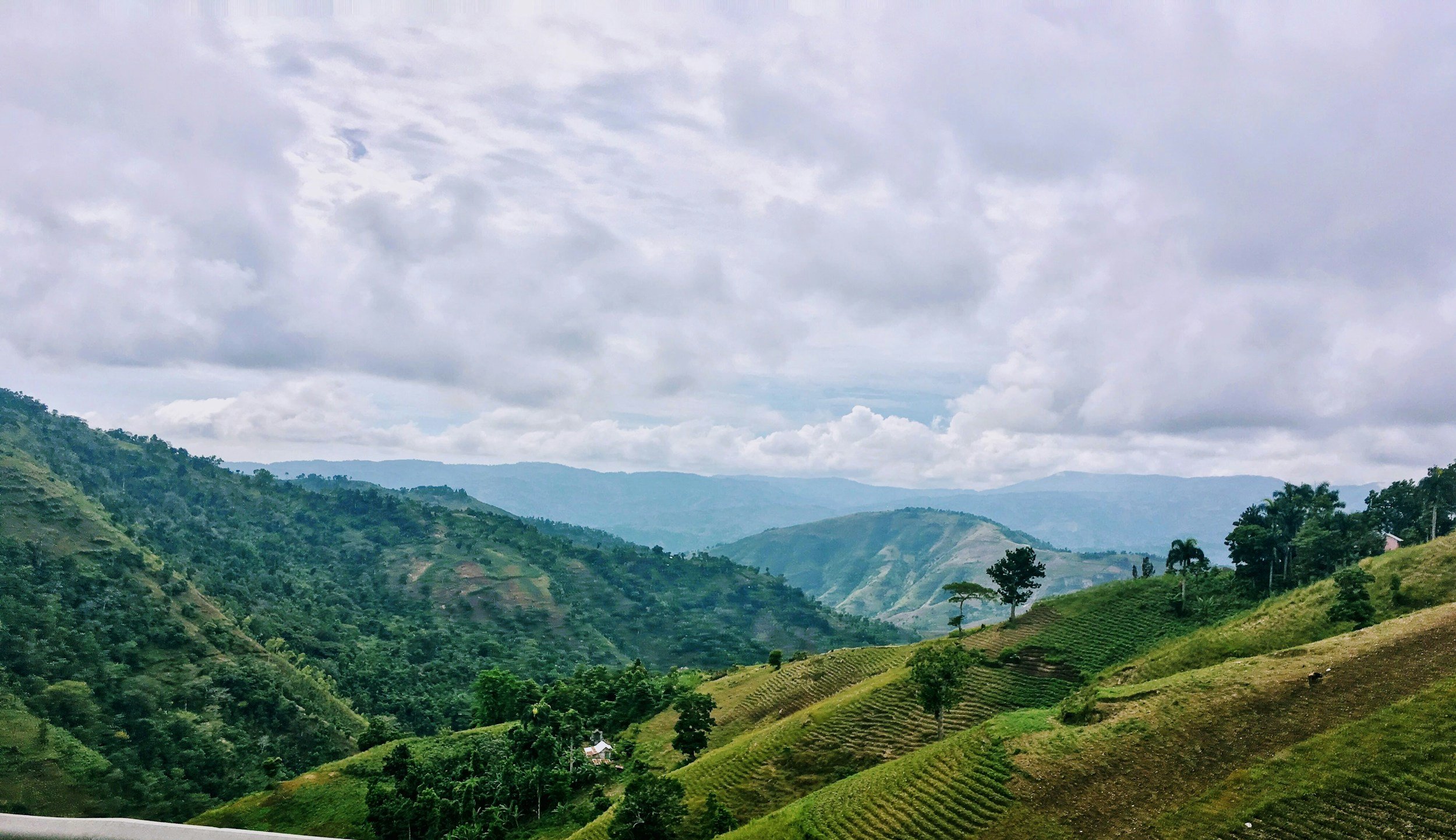
The Ecuadorian Rose Industry: A Global Floricultural Powerhouse
Ecuador's floriculture sector, particularly its rose industry, has grown exponentially over the past three decades to become a major global supplier, capitalizing on unique geographic advantages and strategic policy support.
Success and Economic Impact
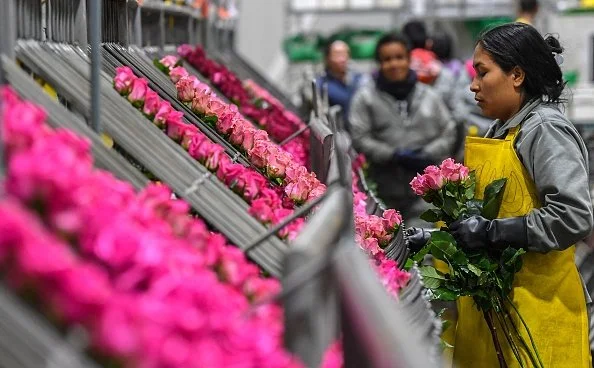
Ecuador is a world leader in cut flower exports, often ranking as the third or fourth-largest global exporter, with roses accounting for the vast majority of this trade. This success is critical to the national economy:
Fiscal and Economic Impact: Flowers are a vital non-petroleum export, generating hundreds of millions of dollars in annual foreign exchange earnings. The industry contributes significantly to the agricultural Gross Domestic Product (GDP).
Local Impact and Employment: The industry is a major job creator, directly and indirectly employing tens of thousands of people, particularly in rural Andean regions like Pichincha, Cotopaxi, and Cayambe. This employment, often providing wages above the minimum wage, is crucial for local economic uplift, with women comprising a significant portion of the workforce, leading to economic empowerment and support for their families and communities. Related tax revenue has been used for local infrastructure projects.
Global Impact: Ecuadorian roses are renowned for their superior quality, including large buds, long stems, vibrant colors, and extended vase life (up to two weeks), making them highly sought after in the United States, Russia, and Europe. This quality sets a high benchmark in the global flower market.
History and Leadership in Floriculture
Ecuador's rise as a floriculture leader is rooted in a unique combination of natural and political factors:
Initial Development (1980s): The industry was introduced in the early 1980s, leveraging Dutch horticultural expertise and technology.
Geographic and Climatic Advantage: This is the primary reason for Ecuador's excellence.
Equatorial Location and Altitude: Located directly on the equator, farms in the Andean highlands (2,800 to 3,000 meters above sea level) receive intense, consistent, year-round sunlight (12 hours of light daily).
Ideal Temperatures: The high altitude provides cool nights (around $10^\circ$C) and warm days (around $21^\circ$C). This combination slows down the rose's growth cycle (up to 15 weeks compared to 8 weeks at sea level), which allows for the development of the signature long, thick stems and large flower heads.
Volcanic Soil: The region's fertile, mineral-rich volcanic soil provides excellent nutrients for robust plant growth.
Strategic Policy Support (The Catalyst):
Andean Trade Preference Act (ATPA, 1991): The enactment of this U.S. policy was a major catalyst. It allowed for the tax-free export of cut flowers to the U.S. as part of an effort to promote legal industries (like floriculture) as an alternative to drug trafficking in Andean countries. This immediately made Ecuadorian flowers more price-competitive.
Innovations and Differentiation
Ecuadorian growers maintain their competitive edge through continuous innovation in quality, variety, and sustainability:
Product Diversification and Hybridization: Growers are constantly partnering with international breeders to develop new rose varieties that meet market demand—seeking unique colors (like terracotta and coral), "garden-like" blooms, and traits that increase productivity, disease resistance, and travel durability. Ecuador now grows over 400 varieties of roses.
Logistics and Cold Chain: Advanced cold chain infrastructure ensures flowers are sorted, graded, packaged, and shipped rapidly (often within 24-48 hours) from farms near major airports like Quito to international destinations, guaranteeing maximum freshness and vase life.
Sustainable Practices (A Growing Focus): In response to past environmental concerns (pesticide/water use), many farms are adopting more sustainable methods, including:
Integrated Pest Management (IPM): Using biological controls (e.g., beneficial fungi) grown in on-site labs to naturally combat pests and diseases, significantly reducing the use of chemical pesticides.
Resource Management: Implementing water recycling, drip irrigation, and exploring the use of solar energy and organic fertilizers.
Carbon Footprint
The floriculture industry, being highly perishable and reliant on air freight, generally has a significant carbon footprint. However, a nuanced view is necessary for Ecuador:
Primary Contributor: The air freight required to quickly transport the delicate product to global markets is the largest element of the carbon footprint.
Mitigating Factor—Lower Energy Use: Ecuador's natural advantages (year-round, intense, natural light and ideal temperatures) significantly reduce the need for artificial lighting, heating, and climate control that are major energy consumers for flower farms in cooler climates (e.g., in the Netherlands or the northern U.S.). This inherent efficiency offsets some of the high-transport-cost emissions.
Industry Response: Farms are increasingly focusing on biodegradable packaging, optimizing transportation methods, and seeking certifications to quantify and reduce their overall environmental impact and appeal to eco-conscious consumers.
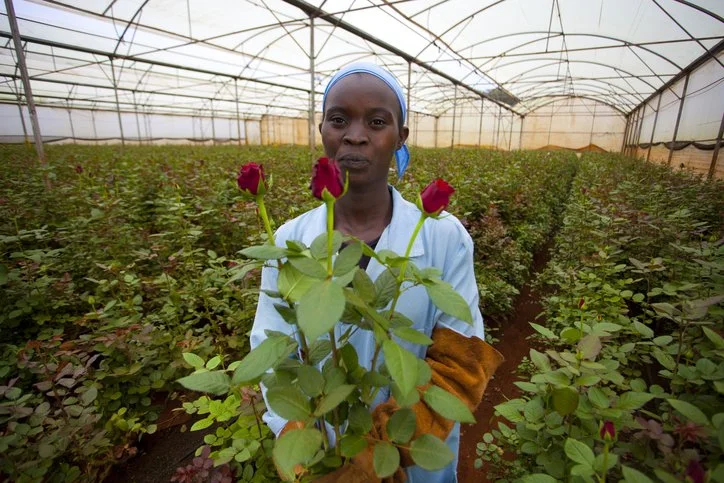
II. Economic Involvement and Indigenous Empowerment
A. Local Ownership Model (Equity and Voice):
Worker-Owned Cooperatives: Structure the farms as majority worker-owned cooperatives from the outset. This ensures profits are retained locally and redistributed, granting workers a true stake in the business's long-term success.
Indigenous/Local Land Rights: Secure legal agreements that establish clear land rights and leasing arrangements that benefit the local communities and indigenous peoples where farms are situated.
Board Representation: Mandate local community and worker representation on the farm's governing boards.
B. Capacity Building and Training:
Technical Transfer: Establish a Floriculture Training Institute (partnership with Ecuadorian consultants) focused on advanced rose cultivation, quality control, post-harvest handling, and sustainable practices (IPM, soil health).
Business Acumen: Provide training for local leaders in supply chain management, export marketing, financial management, and cooperative governance.
C. Social Safeguards: Enforce strict international labor and environmental standards from Day One, ensuring fair wages, safe working conditions, and social security benefits.
III. U.S. Import Strategy (Ally Partner Status)
A. Trade Preference Advocacy:
Seek Parity: Work with the U.S. government to secure trade mechanisms for Hispaniola that grant tariff and quota-free access to the U.S. flower market, similar to the original Andean Trade Preference Act.
"Fair Trade" Certification: Target Fair Trade and other ethical/sustainable certifications to attract premium U.S. buyers and differentiate the product as "ethically grown."
B. Marketing as an "Ally Partner":
Messaging: Brand the flowers as a premium product from an "Ally Partner" and a source of human development and resilience (especially for Haiti).
Supply Chain Resilience: Position Hispaniola as a more logistically resilient and geographically closer alternative to distant flower sources, reducing freight time and risk for U.S. wholesalers.
C. U.S. Government Procurement: Advocate for a mandate within U.S. government procurement (e.g., military bases, federal buildings) to preferentially source flowers from the Hispaniola initiative, guaranteeing an initial stable buyer.
Outline Plan: Bringing the Flower Industry to Hispaniola
The following plan outlines a proposed initiative to establish a high-quality, export-oriented rose and flower industry in Hispaniola (Dominican Republic and Haiti), leveraging the economic success model of Ecuador while prioritizing local ownership and sustainable development as a core mandate for the UN.
I. Project Foundation and Vision
A. Vision Statement: Establish a high-value, sustainable, locally-owned floriculture export industry in Hispaniola that promotes economic stability, empowers indigenous and local communities, and secures a competitive position as a preferred flower supplier to the North American market.
B. Core Mandates:
Economic Empowerment: Structured local ownership model (cooperatives/equity sharing).
Environmental Sustainability: Adoption of advanced water conservation and biological pest control from inception.
Logistical Efficiency: Proximity to the U.S. as a key competitive advantage.
C. Key Partners: UN Agencies (e.g., UNDP, FAO), Local and National Governments (DR and Haiti), U.S. International Development Finance Corporation (DFC), Ecuadorian Floriculture Experts/Consultants.
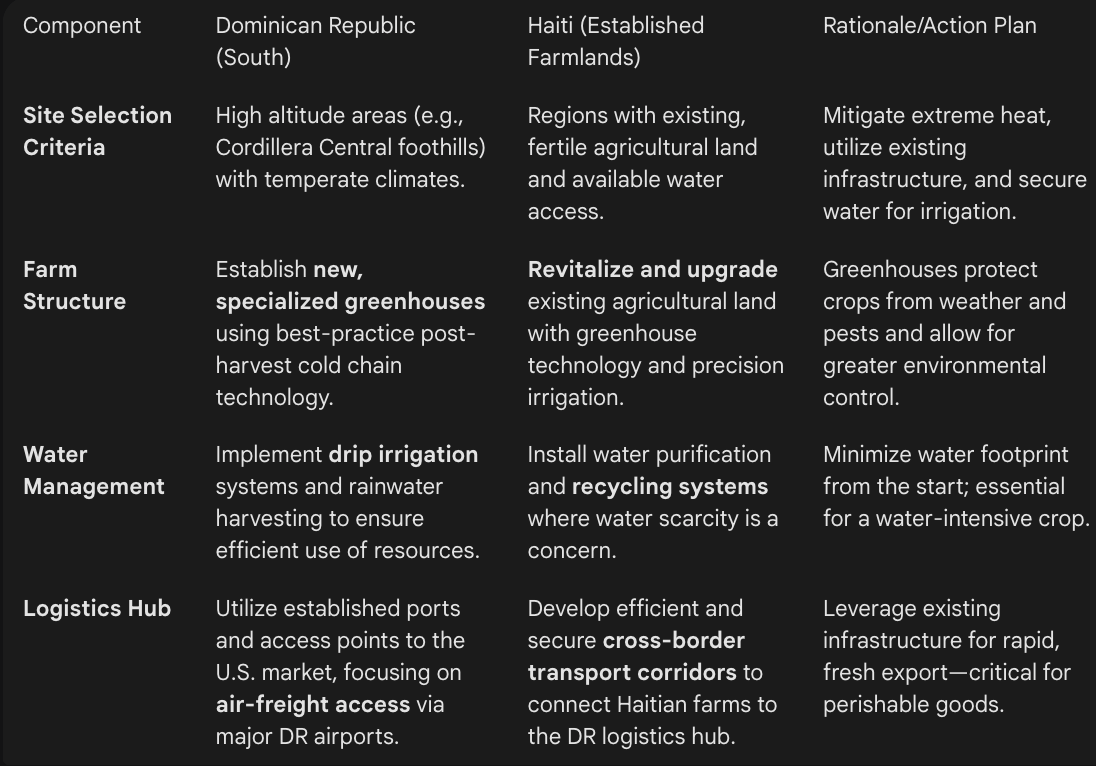
Soil and Site Selection
There are agricultural areas in the Dominican Republic that feature volcanic or volcanically-derived soil, which is highly beneficial for farming.
While the Dominican Republic is not as dominantly volcanic as some smaller Caribbean islands (like Dominica or Saint Lucia), its geological history, particularly the formation of its major mountain ranges, involves ancient volcanic activity.
Here are the key points regarding volcanic soil in the Dominican Republic:
Geological Origin: Hispaniola, the island shared by the Dominican Republic and Haiti, was formed through the collision of several volcanic island arcs, particularly in the Cretaceous and Paleogene periods.
Location in Mountain Ranges: The main mountain ranges, especially the Cordillera Central, which runs through the center of the island, contain rock formations of volcanic origin. The weathering of these rocks over millennia contributes to fertile soil in the surrounding valleys and high-altitude agricultural regions.
Fertility: This soil, often described as rich and well-drained, is excellent for a variety of high-value crops.
Areas like the Cibao Valley, which is the largest and most fertile in the country, benefit from sediment and weathered materials from the central mountain range.
High-altitude crops like world-class Arabica coffee and luxurious dark cocoa thrive in these mountainous regions, suggesting the presence of nutrient-rich, favorable soils, which can be characteristic of volcanic origin.
Relevance to Roses: For your plan to bring the rose industry to the Dominican Republic, the high-altitude regions in the Cordillera Central are the most promising, not just for the cooler temperatures and sun exposure (like Ecuador) but also for the presence of this fertile, volcanically-influenced soil.
The goal would be to locate the farms in the high-altitude foothills of the Cordillera Central to capture the optimal combination of altitude/climate (Ecuador's key advantage) and rich soil (the quality boost).
HAITI
Volcanic Soil Presence and Challenges
Presence of Volcanic Parent Rock: Haiti is extremely mountainous, and its geologic foundation, like the rest of Hispaniola, is composed of different varieties of limestone and volcanic materials. Therefore, the agricultural soil (pedogenesis) in many regions begins with the weathering of this volcanic rock.
The Critical Challenge: Erosion: Despite the presence of suitable parent material, centuries of deforestation (largely for charcoal production) combined with Haiti's steep, rugged terrain and tropical rainfall have led to severe soil erosion.
Most of the fertile topsoil has been lost, leaving behind shallow, fragile, and often nutrient-depleted soils.
The dominant soil types are often shallow Inceptisols and highly leached Ultisols, which are of low native fertility and highly susceptible to erosion.